
Date of Visit: February 17, 2025
Location: Narnarayan Shastri Institute of Technology (NSIT), Jetalpur, Ahmedabad
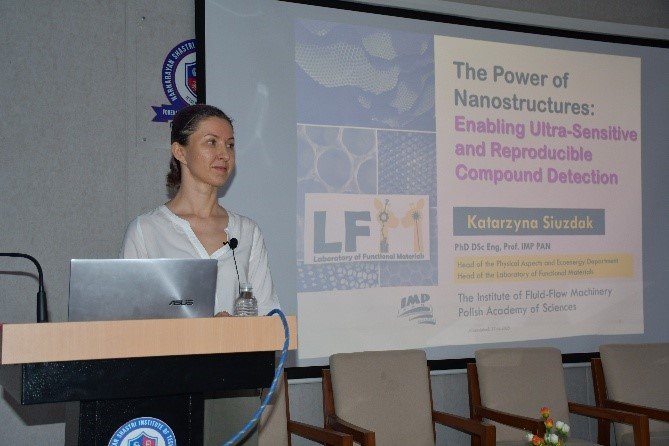
Narnarayan Shastri Institute of Technology (NSIT) hosted an inspiring Expert Talk on “The Power of Nanostructures Enabling Ultra-Sensitive and Reproducible Compound Detection”, featuring PhD D.Sc Eng. Dr. Katarzyna Siuzdak, Associate Professor from The Institute of Flued Flow Machinery. Polish Academy of Science Poland.
Session Highlights:
The event began with a warm welcome for Dr. Katarzyna Siuzdak, who was received with a traditional tilak ceremony. Following the ceremonial lighting of the lamp, the Principal, Prof. Dr. Nikunj Brahmbhatt, delivered an inspiring speech, emphasizing the significance of the topic and introducing the notable achievements of the guest speaker.
Dr. Katarzyna Siuzdak’s talk covered a range of topics Nanostructures are emerging as key enablers in the detection of chemical compounds at ultra-sensitive levels. Their unique properties, such as large surface area, tunable size, and high reactivity, make them ideal candidates for improving detection sensitivity and ensuring reproducibility in various applications, including environmental monitoring, healthcare diagnostics, and industrial processes. This session explores the latest advancements in nanostructure-based technologies and how they are transforming the field of compound detection. She discussed emerging career opportunities in cyber forensics, emphasizing the growing demand for skilled professionals in fields like:
- Fundamentals of Nanostructures: Understanding the inherent properties of nanomaterials, such as quantum effects and surface plasmon resonance, which contribute to their enhanced sensing capabilities.
- Design and Fabrication: A look into the cutting-edge design principles and fabrication techniques that enable the creation of highly sensitive and reproducible nanosensors.
- Applications Across Sectors: Real-world case studies demonstrating how these advanced sensors are used in fields like medical diagnostics, environmental monitoring, and food safety.
- Challenges and Future Directions: Discussing the hurdles in achieving scalability, cost-effectiveness, and long-term stability for commercial applications, and what the future holds for nanostructure-based compound detection.
In this expert talk, attendees delve into how nanostructures are revolutionizing the way we detect compounds at unprecedented levels of sensitivity and reliability. Nanomaterials exhibit extraordinary properties that enable the detection of even trace amounts of chemical compounds with high precision. By manipulating the size, shape, and surface characteristics of nanostructures, researchers can create sensors that outperform traditional detection methods in both sensitivity and specificity.
Audience and Participation:
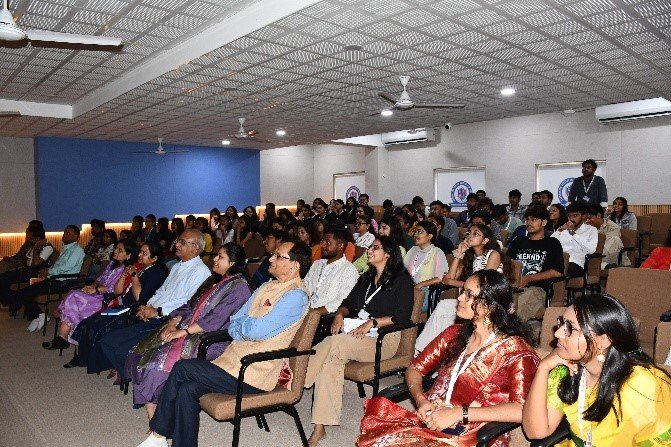
The event was attended by students and faculty members from various departments, including those pursuing Master’s and Bachelor’s programs in forensic science. Attendees expressed their admiration for Dr. Katarzyna Siuzdak’s groundbreaking work and appreciated the depth of his session.
Recognition and Gratitude:
To honor Dr. Katarzyna Siuzdak’s contributions Prof. Dr. Nikunj Brahmbhatt presented him with a bouquet, and a memento as tokens of appreciation.
Impact and Takeaway:
This session will provide valuable insights for anyone interested in the intersection of nanotechnology and chemical sensing, offering both technical knowledge and a vision of where this rapidly evolving field is headed.
NSIT continues its tradition of organizing such insightful events to inspire and educate its academic community.
Highlights in Pictures

Conclusion:
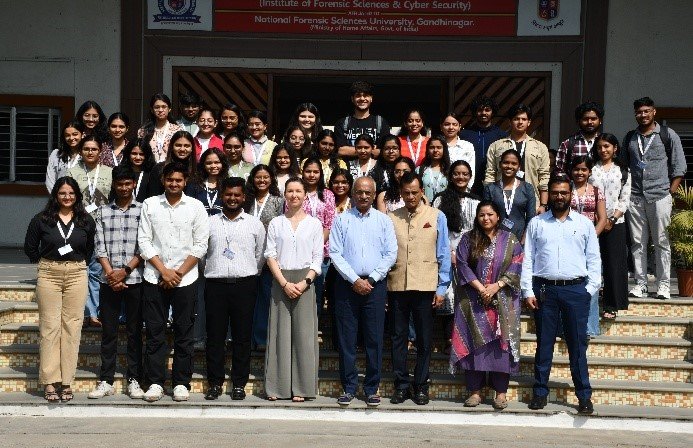
The event concluded with a group photo session at the venue’s entrance, allowing students, volunteers, and faculty members to interact with the guests. A networking lunch followed, offering participants the opportunity to engage in informal discussions with Dr. Katarzyna Siuzdak.
Date: 20.02.2024
Miss Hepi Suthar
Asst. Professor, NSIT-IFSCS
