
Institute Name: NSIT-IFSCS
Event Title: 4-Day Faculty Development Program (FDP)
Dates: 26th December 2024 – 30th December 2024
Duration: 4 Days
Location: NSIT-IFSCS, Swaminarayan Gurukul Campus, Jetalpur, Gujarat 382427
Attendees: All Faculty members of NSIT-IFSCS
Overview:
The 4-Day Faculty Development Program (FDP) held by our Institute aimed at enhancing the professional development of the faculty members, enriching their teaching methods, improving personal well-being, and equipping them with essential life skills. The FDP included a combination of wellness activities, expert talks, and hands-on sessions covering topics ranging from teaching techniques and time management to financial literacy and technical skills.
Faculty Development Program (FDP) 2024 - Event Timetable
| Day | Date | Time | Session Title | Speaker |
|---|---|---|---|---|
| 1 | 26.12.2024 | 9:00 AM – 12:30 PM | Art of Living Program – Yoga for Wellness | Mr. Pragnesh Shah (Art of Living Foundation) |
| 1 | 26.12.2024 | 1:30 PM – 4:00 PM | Effective Teaching | Prof. Kiran Parmar (GTU) |
| 1 | 26.12.2024 | 4:15 PM – 5:15 PM | Time Management | Prof. Kiran Parmar (GTU) |
| 2 | 27.12.2024 | 9:00 AM – 12:30 PM | Art of Living Program – Yoga for Wellness | Mr. Pragnesh Shah (Art of Living Foundation) |
| 2 | 27.12.2024 | 1:30 PM – 2:30 PM | Basics of State Government Administrative Machinery | Ms. Charu Lata (Advisor to Management, NSIT) |
| 2 | 27.12.2024 | 2:45 PM – 3:45 PM | Introduction to Forensic Science | Prof. K.V. Ravi Kumar (NSIT-IFSCS) |
| 2 | 27.12.2024 | 4:00 PM – 5:00 PM | How to Write a Research Proposal | Dr. Harjeet Singh (NSIT-IFSCS) |
| 3 | 28.12.2024 | 9:00 AM – 12:30 PM | Art of Living Program – Yoga for Wellness | Mr. Pragnesh Shah (Art of Living Foundation) |
| 3 | 28.12.2024 | 1:30 PM – 4:30 PM | Financial Literacy | Mr. Ashish Shah (Certified Financial Planner) |
| 4 | 28.12.2024 | 9:00 AM – 4:00 PM | SPSS (Statistical Tool) | Dr. Priyal Sanghvi (Som-Lalit Management College) |
Abstract of the Event
The 4-Day Faculty Development Program (FDP) organized by NSIT-IFSCS from 26th December 2024 to 30th December 2024 was designed to enhance the professional and personal development of faculty members. The event offered a balanced mix of wellness activities, expert talks, and technical training. The Art of Living Program – Yoga for Wellness, conducted over three days, provided faculty with stress-reducing yoga, pranayama, and meditation techniques that focused on mental clarity, physical flexibility, and well-being.
Key sessions included Prof. Kiran Parmar’s talks on “Effective Teaching” and “Time Management,” where faculty learned how to create engaging lectures and manage their time effectively. Additionally, Ms. Charu Lata provided insights into state government administrative functions, which enriched the faculty’s understanding of governance and policy. Financial literacy was another critical focus, where Mr. Ashish Shah shared techniques for personal finance management, ensuring faculty members could make informed investment decisions.
On the final day, Dr. Priyal Sanghvi conducted a comprehensive workshop on SPSS (Statistical Package for the Social Sciences), teaching faculty essential data analysis skills to support research projects. This diverse program provided faculty with valuable tools to improve their teaching effectiveness, personal wellness, and professional expertise, ensuring their continued success in academia.
Day 1-3: December 26-28, 2024
Session 1 (Day 1-3): Art of Living Program - Yoga for Wellness
- Instructor: Mr. Pragnesh Shah (Art of Living Foundation)
- Duration: 10.5 hours (3 sessions of 3.5 hours each)
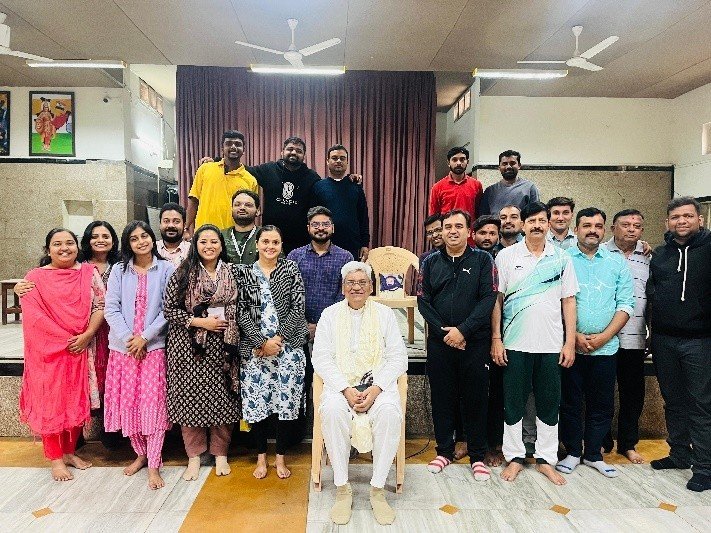
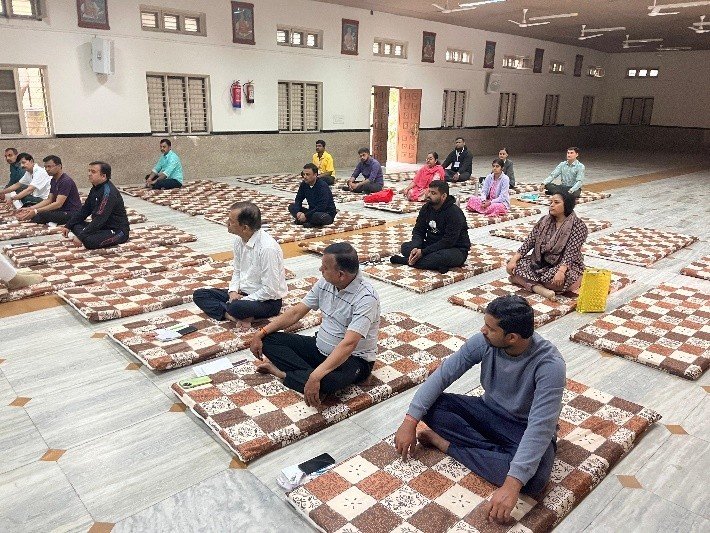
- Details:The Art of Living Program, led by Pragnesh Shah, was conducted over three days and focused on mental and physical wellness through yoga, meditation, and pranayama. The program aimed to reduce stress, improve mental clarity, and promote physical flexibility, providing a peaceful foundation for the FDP. The faculty members learned various breathing exercises (pranayama), yoga postures (asanas), and meditation techniques, which helped them stay focused, calm, and balanced in their professional and personal lives. These sessions were key to improving overall well-being and fostering a productive and mindful environment for the entire program.
Session 2: Effective Teaching
- Speaker: Prof. Kiran Parmar (GTU)
- Duration: 2.5 hours
- Details:
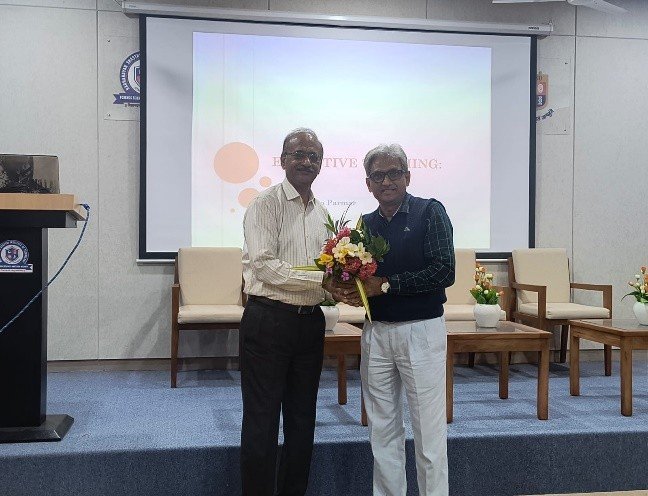
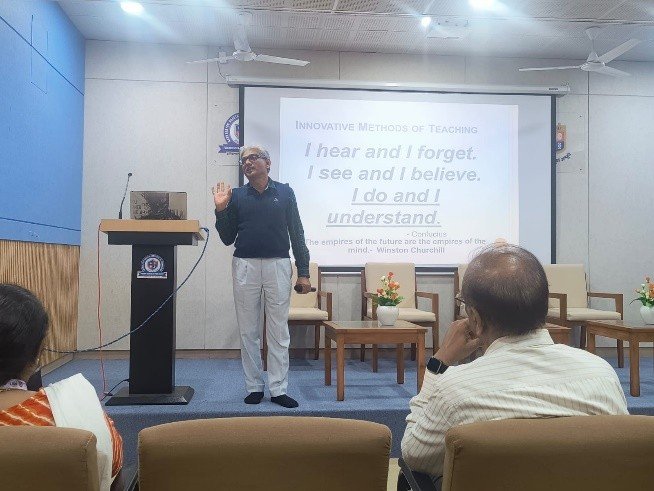
Following the yoga session, Prof. Kiran Parmar, a renowned academician from Gujarat Technological University (GTU), led a session on “Effective Teaching.” He discussed various pedagogical techniques, focusing on how to make lectures more engaging, how to handle classroom dynamics effectively, and how to use technology to enhance learning outcomes. Prof. Parmar also shared insights on how faculty members can improve their own teaching strategies, keeping students motivated and making learning more impactful.
Session 3: Time Management
- Speaker: Prof. Kiran Parmar (GTU)
- Duration: 1 hours
- Details:
In the second part of Prof. Kiran Parmar’s session, the focus shifted to “Time Management,” a critical skill for faculty members. Prof. Parmar provided practical tips and strategies for balancing multiple responsibilities—teaching, research, administration, and personal commitments. He emphasized prioritization, effective planning, and avoiding procrastination to improve productivity. Faculty members actively participated in time management exercises, which helped them reflect on their current practices and identify areas of improvement.
Day 2: 27th December 2024
Session 2: Basics of State Government Administrative Machinery
- Speaker: Ms. Charu Lata (Advisor to Management, NSIT)
- Duration: 1 hours
- Details:
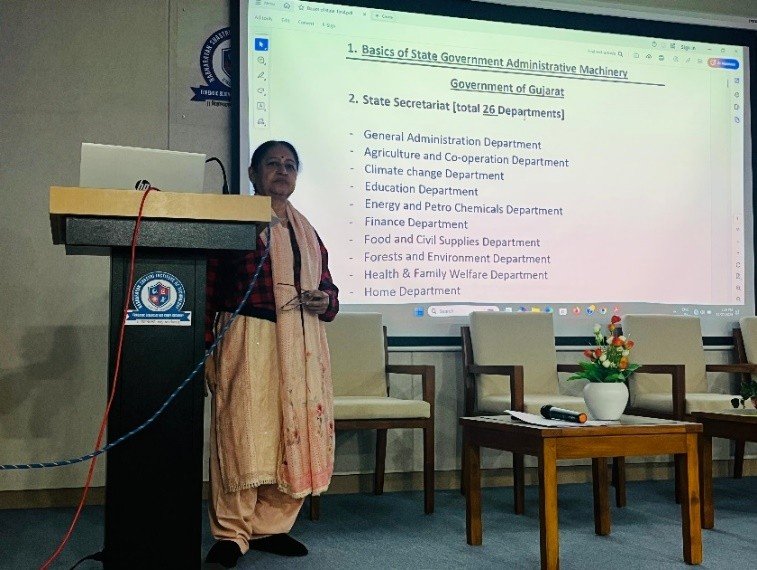
Following the wellness session, Ms. Charu Lata, a Trustee Member at NSIT, presented an expert talk on the “Basics of State Government Administrative Machinery.” She provided a comprehensive overview of how state government functions, explaining the roles and responsibilities of various administrative departments. The session offered a deeper understanding of the governmental structures and procedures, which was particularly useful for faculty members involved in research, policy analysis, or public administration studies. Ms. Lata also shared practical insights into how these systems impact education and research at the state level.
Session 3: Introduction to Forensic Science
- Speaker: Prof. K.V. Ravi Kumar (Director, Training and Consultancy, NSIT-IFSCS)
- Duration: Approx. 1 hour
- Details:
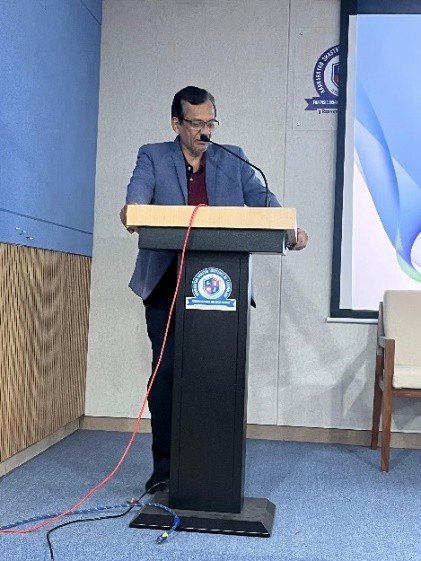
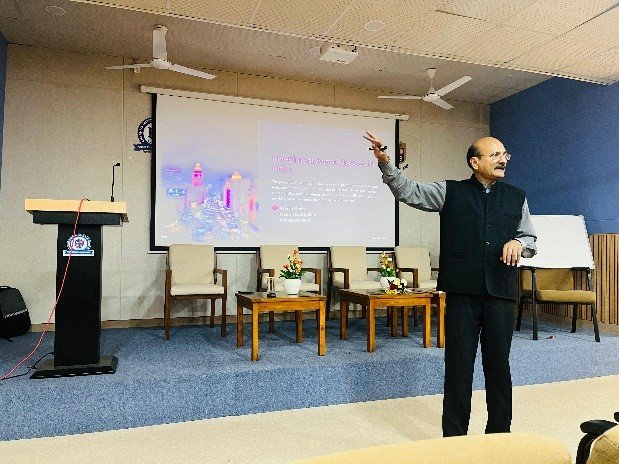
The final session of the FDP provided an insightful introduction to the field of Forensic Science, led by Prof. K.V. Ravi Kumar, the Director of Training and Consultancy at NSIT-IFSCS. Prof. Kumar shared the fascinating history of Forensic Science, tracing its evolution from ancient methods of crime investigation to modern, scientific techniques used in criminal justice today. He highlighted key milestones, such as the development of fingerprinting, DNA profiling, and the use of forensic pathology, which have revolutionized criminal investigations. The session also covered the importance of forensic science in law enforcement and its role in ensuring justice. Prof. Kumar’s engaging lecture was filled with historical anecdotes and practical examples, sparking interest in the faculty and providing a broad understanding of the subject.
Session 4: How to Write a Research Proposal
- Speaker: Dr. Harjeet Singh (Asst. Professor, NSIT-IFSCS)
- Duration: Approx. 1 hours
- Details:
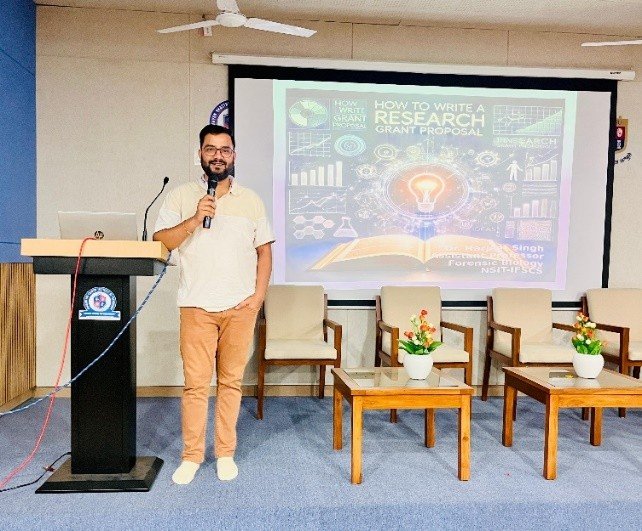
The final session of the FDP was led by Dr. Harjeet Singh, who provided faculty members with valuable insights into the art of writing a research proposal. This session aimed to equip the participants with the essential tools and strategies for creating well-structured and impactful research proposals. Dr. Singh discussed the key components of a research proposal, including the introduction, literature review, research objectives, methodology, and expected outcomes. He emphasized the importance of clarity, coherence, and alignment with funding agency guidelines when drafting proposals. Practical examples and tips were shared to help faculty members avoid common pitfalls and present their ideas effectively to funding bodies. The session concluded with a Q&A, where participants could clarify their doubts and share their experiences in research proposal writing. By the end of the session, faculty members gained a deeper understanding of how to craft persuasive proposals that can attract funding and support for their research projects.
Day 3: 28th December 2024
Session 2: Financial Literacy
- Speaker: Mr. Ashish Shah (Govt. Certified Financial Planner)
- Duration: 3 hours
- Details:
Mr. Ashish Shah, a Certified Financial Planner, conducted an insightful session on “Financial Literacy.” He discussed the importance of financial planning, how to make smart investment decisions, and how faculty members can manage their finances to secure their future. The session covered key financial tools, such as mutual funds, insurance, retirement planning, and tax-saving options. The session was highly interactive, with Mr. Shah addressing queries from the faculty about personal finance, creating wealth, and preparing for financial emergencies. Participants left with a better understanding of how to manage their money effectively.

Day 4: 30th December 2024
Session 1: SPSS (Statistical Tool)
- Speaker: Dr. Priyal Sanghvi (Som-Lalit Management College)
- Duration: Full Day (Approx. 6 hours)
- Details:
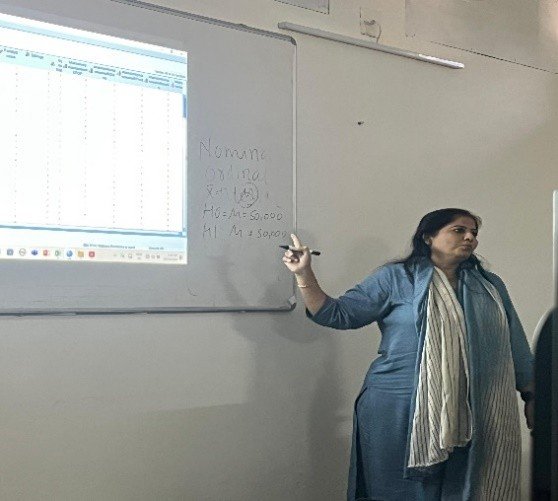
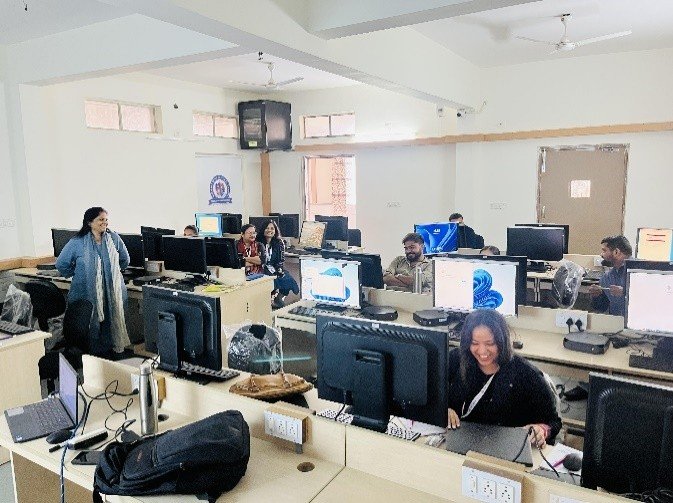
The final day of the Faculty Development Program (FDP) was dedicated entirely to SPSS (Statistical Package for the Social Sciences), conducted by Dr. Priyal Sanghvi. Dr. Sanghvi, an expert in statistical methods and data analysis, took the participants through an intensive, hands-on session on the use of SPSS, which is an essential tool for faculty members engaged in research and academic data analysis.
The day-long workshop was structured in a detailed, step-by-step format, allowing the participants to explore the various features of SPSS in depth. The session covered both basic and advanced techniques, equipping the faculty members with the skills necessary to use SPSS effectively for analyzing and interpreting research data.
Morning Session (Introduction to SPSS)
- Introduction to SPSS Interface: Dr. Sanghvi began by introducing the software, showing faculty members how to navigate the SPSS interface, including how to open and save data files, manage datasets, and use various menus and options.
- Data Entry & Organization: The session then focused on the essential aspect of data entry. Dr. Sanghvi explained how to structure data in SPSS, including variable types, labels, and values, ensuring that the data was organized for easy manipulation and analysis.
- Data Cleaning: Dr. Sanghvi emphasized the importance of data cleaning, demonstrating how to check for and handle missing values, outliers, and errors in the dataset, ensuring that the data was valid and ready for analysis.
Mid-Morning Session (Basic Statistical Analysis)
- Descriptive Statistics: The next part of the session introduced basic statistical functions, starting with descriptive statistics. Dr. Sanghvi demonstrated how to calculate means, medians, standard deviations, and frequencies, and how to interpret the results.
- Data Visualization: Dr. Sanghvi highlighted the importance of visualizing data for better understanding and interpretation. Participants were guided on how to create histograms, bar charts, and pie charts in SPSS to represent their data graphically.
Afternoon Session (Advanced Statistical Techniques)
- T-tests & ANOVA: In the afternoon session, the focus shifted to more advanced statistical techniques. Dr. Sanghvi explained how to conduct and interpret t-tests (both paired and unpaired) and Analysis of Variance (ANOVA), tools used to compare groups and test hypotheses. Participants practiced these tests with real-world examples, analyzing differences between groups and understanding statistical significance.
- Correlation and Regression Analysis: Next, the participants learned how to perform correlation and regression analysis, two crucial methods for studying relationships between variables. Dr. Sanghvi explained how to interpret Pearson’s correlation coefficient and run linear regression models in SPSS to predict outcomes.
- Chi-Square Tests: Dr. Sanghvi also covered Chi-Square tests, which are essential for categorical data analysis. The faculty members learned how to test the independence of variables and understand the output from SPSS, including the p-values and contingency tables.
Late Afternoon Session (Interpreting Results and Reporting)
- Interpreting SPSS Output: As the session neared its conclusion, Dr. Sanghvi demonstrated how to interpret and report the results generated by SPSS. Faculty members were shown how to read SPSS output, including the significance values, confidence intervals, and test statistics, and how to translate these results into clear, understandable reports for academic papers and research presentations.
- Hands-on Exercises: Throughout the session, Dr. Sanghvi encouraged active participation by asking faculty members to perform the various analyses on sample datasets. This ensured that the participants not only learned the theory behind each statistical test but also gained practical experience in applying the tools.
By the end of the day, faculty members were proficient in using SPSS for a wide range of statistical analyses and were equipped with the necessary skills to implement SPSS in their own research projects.
Conclusion:
In conclusion, the 4-Day Faculty Development Program (FDP) at NSIT-IFSCS proved to be an enriching and transformative experience for all participants. The program effectively blended wellness, pedagogical skills, technical training, and financial literacy, catering to the multifaceted needs of faculty members. The wellness sessions, led by Pragnesh Shah from the Art of Living Foundation, laid the foundation for mental and physical well-being, offering valuable tools for stress reduction and focus enhancement through yoga and meditation. Prof. Kiran Parmar’s sessions on effective teaching and time management empowered faculty with innovative teaching techniques and practical time-saving strategies. The session on state government machinery by Ms. Charu Lata provided an insightful understanding of administrative structures, enriching the faculty’s knowledge of governance. Financial literacy training by Mr. Ashish Shah equipped participants with essential skills to manage personal finances. Finally, Dr. Priyal Sanghvi’s comprehensive workshop on SPSS offered hands-on experience with advanced statistical tools, enhancing faculty research capabilities. Collectively, the FDP not only strengthened faculty members’ professional skills but also promoted holistic development, leaving participants well-prepared to excel in their academic roles while maintaining personal well-being. The program successfully achieved its goal of fostering continuous growth and development in a supportive learning environment.
